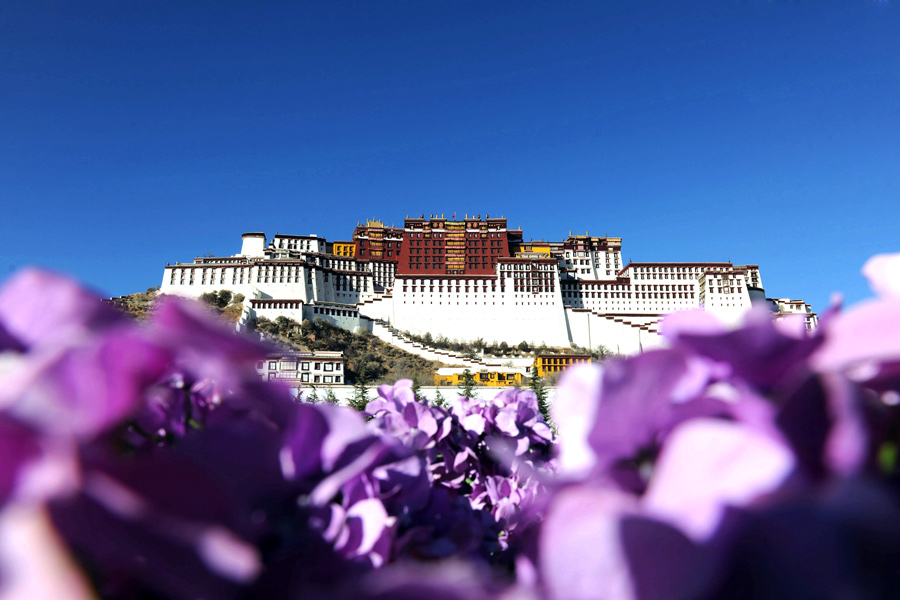
Historic Ensemble of the Potala Palace, Lhasa
拉萨布达拉宫历史建筑群
- 分类: 文化遗产
- ID: 1861747398312521729
Home CategoryCultural HeritageHistoric Ensemble of the Potala Palace, LhasaPlay8 minsThe Potala Palace, the winter residence of the Dalai Lama, has symbolized Tibetan Buddhism and its central role in the traditional administration of Tibet since the 7th century. The complex, comprising the White and Red Palaces and their ancillary buildings, is built on Red Mountain in the center of the Lhasa Valley, at an altitude of 3,700 meters.ShareRelated Videos**Potala Palace digitizes nearly 1,000 precious thangkas 00:04:35Catalogue1. Brief Introduction2. Cultural Heritage3. Tibetan Buddhism4. LegendsCategory of Site: Cultural Site
Brief Introduction
The Potala Palace, the winter residence of the Dalai Lama, has symbolized Tibetan Buddhism and its central role in the traditional administration of Tibet since the 7th century. The complex, comprising the White and Red Palaces and their ancillary buildings, is built on Red Mountain in the center of the Lhasa Valley, at an altitude of 3,700 meters. The Jokhang Temple Monastery, founded in the 7th century, is an exceptional Buddhist religious complex. Norbulingka, the Dalai Lama's former summer palace, built in the 18th century, is a masterpiece of Tibetan art. The beauty and originality of the architecture of the Historic Ensemble of the Potala Palace, along with its rich ornamentation and harmonious integration into a striking landscape, add to its historical and religious significance.
Situated on Potala Mountain in Lhasa, the capital of the Xizang autonomous region, the palace was first built in the 7th century for the wedding of the Tibetan king Songtsan Gompo and Princess Wencheng of the Tang Dynasty (618-907). Since its completion, the palace has been expanded many times. In 1645, the 5th Dalai Lama was appointed as the local temporal and religious leader of Tibet, and the palace was reconstructed. In 1653, the 5th Dalai Lama moved from Drepung Monastery to the palace, making it the political center of Tibet.
The palace's halls include worship and pagoda halls, the North Square, the South Square, and the Dragon King Pond. The main building has 13 floors, with a height of about 110 meters and a width of about 360 meters. It is surrounded by eight temples, which house tens of thousands of Buddhist statues. In the Buddhist Practice Cave are preserved paintings of Songtsan Gompo and Wencheng from the 7th century. The pagodas in the pagoda halls for each Dalai Lama are well-built, especially the pagoda for the 5th Dalai Lama, which is covered in gold and decorated with valuable jewels. Another important building is Qingsha, where the ministers for Tibetan affairs of the Qing Dynasty (1644-1911) presided over the inauguration of the Dalai Lamas.
First built in 647 and located in the center of Lhasa, the Jokhang Monastery is Tibet's oldest wood-and-stone building. Covering a total area of 25,100 square meters, the monastery consists of temples and scripture halls. The main Buddhist Hall has four stories, and the gilded copper statue of Sakyamuni brought by Princess Wencheng is still worshipped in its own hall. In front of the monastery stands a monument to the establishment of alliance relations between the Tang Dynasty and Tibet, as well as a willow tree planted by Princess Wencheng. These are historical evidence of over 1,000 years of friendship between the Han and Tibetan peoples. The front of the monument is inscribed with the history of the monument in both Chinese and Tibetan, detailing the process and significance of the alliance.
Norbulingka, the Dalai Lama's former summer palace, constructed in the 18th century, is situated on the bank of the Lhasa River about 2 km west of the Potala Palace in a lush green environment. It consists of a large garden with four palace complexes, a monastery, and other halls and pavilions, all integrated into the garden layout to create an exceptional work of art covering 36 hectares. The property is closely related to religious and political matters, having been a place for contemplation and for signing political agreements.
The Potala Palace, Jokhang Temple Monastery, and Norbulingka were added to the World Heritage list in 1994, 2000, and 2001, respectively.
Cultural Heritage
The Historic Ensemble of the Potala Palace is an exceptional work of human imagination and creativity, in terms of its design, decoration, and harmonious setting within a dramatic landscape. The three-in-one historic ensemble of the Potala Palace, including the palace-fort complex, Norbulingka garden residence, and the Jokhang Temple Monastery, each with its distinctive characteristics, forms an excellent example of traditional Tibetan architecture.
The scale and artistic wealth of the Historic Ensemble of the Potala Palace, symbolizing the pinnacle of Tibetan architecture, make it an outstanding example of the last surviving theocratic architecture in the modern world. The palace is renowned not only for its magnificent building but also for its delicate furnishings, including carvings and paintings.
The Historic Ensemble of the Potala Palace stands as a potent and outstanding symbol of the integration of secular and religious authority. The palace is the most successful structure integrating Tibetan Buddhism with palace architecture among numerous Tibetan monumental buildings.
The palace used to be a center for both temporal and religious administration. It is closely connected with many important figures in the history of Xizang, such as Songtsan Gompo, Princess Wencheng, and several generations of Dalai Lamas.
Tibetan Buddhism
Potala is a transliterated Sanskrit word. It is said that Tibetan Buddhists believed that Mt. Hongshan, the original name of Potala Mountain, was as pure as Potaraka Mountain, the sacred place where the Bodhisattva Avalokitesvara lived. So they renamed the mountain. When the palace was built, it was named after this sacred mountain.
Tibetan Buddhism adheres to the doctrine of the Three Realms: the desire realm, the form realm, and the formless realm. The vertical layout of the Potala Palace—from the Red Palace at the top to the White Palace at the bottom—corresponds to this Buddhist doctrine. The expanded size and striking contrast in layout fully demonstrate the power and dignity of Buddhism. The symbolic appearance of the palace suggests that only by detaching oneself from the secular world and converting to Buddhism can one reach the Heavenly Paradise.
Legends
Located on Barkhor Street in Lhasa, the Jokhang Monastery was first built in the mid-7th century. It is said that Lhasa was still a vast swampland when Princess Wencheng arrived. She found no Buddhist temple there and had to set up her statue of Sakyamuni in a tent. By observing the terrain of Lhasa, the princess believed that the whole place resembled the figure of a female demon. To conquer this demon, the princess decided to fill in the swamp and build a large Buddhist temple. She hoped that the boundless power of Sakyamuni could bring stability and prosperity to the local people. Her proposal was actively supported by Songtsan Gompo, who ordered the construction at once and even participated in some of the labor. Two years later, the grand Jokhang Monastery was completed. As it attracted more and more monks, Lhasa became prosperous.
Article reference1. The Potala Palace. en.chinaculture.org. 20232. Historic Ensemble of the Potala Palace, Lhasa. chinadaily.com.cn. 2018Photo Gallery(28 pictures)CategoriesCultural HeritageTagWorld Heritage in ChinaWorld HeritageTangible Cultural HeritageHistorical BuildingArchitectureCatalogue1. Brief Introduction2. Cultural Heritage3. Tibetan Buddhism4. Legends-
- []
来源: Culturepedia - Historic Ensemble of the Potala Palace, Lhasa








